As OpenAI prepares to introduce ads into ChatGPT’s free and Go tiers in the coming weeks, businesses and marketers are curious about how this new chatgpt advertising landscape will work. The assistant began as an AI curiosity but is now a mainstream tool. According to OpenAI’s announcement, the company plans to start testing ads in the U.S. for logged‑in adults on the free and low‑cost Go plan.These ads will appear at the bottom of a response, be clearly labeled, and will not influence ChatGPT’s responses.
With more than 800 million weekly active users as of October 2025, the opportunity for advertisers is enormous. This article explains why ads are coming, how the AI‑powered ad system will work, and what you can do to prepare and succeed once chatgpt advertising goes live.
What Is ChatGPT Advertising and Why Are Ads Coming?
ChatGPT advertising is coming because OpenAI needs a sustainable way to keep its artificial‑intelligence tools accessible and fund development of ever‑larger AI models. Under the current plan, OpenAI said it will introduce ads only on the free and Go subscriptions and keep Plus, Pro, Business and Enterprise tiers ad‑free. Ads are scheduled to be tested in the coming weeks, and they will appear separately from the organic answer. This shift marks a new advertising platform for conversation‑based search that could be transformative for small businesses and brands, especially when you consider the chatbot processes billions of tokens per minute and has hundreds of millions of weekly users.
Why take this step now? In the past, OpenAI CEO Sam Altman described advertising as a last resort business model, but soaring infrastructure costs and the desire to keep the base product free are driving the change. This marks an AI‑driven revenue experiment that could subsidize access for millions. OpenAI plans to keep answers separate from sponsored messages so that conversations feel natural. Analysts note that ads are likely to become a significant revenue stream, given the scale of ChatGPT users, but sloppy execution could drive users to competitors. By keeping ads separate, OpenAI believes it can balance monetization with trust and user experience, a principle spelled out in its advertising guidelines.
How Will ChatGPT Ads Work Within Conversations?
The company says ads in ChatGPT will be unobtrusive yet useful. When a user asks a question, a small banner ad or product recommendation may appear at the bottom of the answer, this is where the ads will appear. For example, someone searching for dinner recipes might receive a sponsored listing for hot sauce. Each chatgpt ad will be clearly labeled so you can tell it’s promotional. The placement is reminiscent of traditional search ads but within a conversational interface. Because sponsored products are tied to the conversation, you might see an ad that feels more like a helpful suggestion than an interruption. These placements harness AI to interpret intent and match relevant offerings.
Importantly, ads will not compromise privacy. Conversations with ChatGPT remain confidential, OpenAI states that your chats are private from advertisers, and it never sells your data. Users will be able to learn why they see a particular ad, dismiss it and turn off personalization, and even clear the data used for ads. During the test phase, only adults will see ads; under‑18 accounts and conversations about sensitive topics like politics or health won’t display promotions. These protections help ensure that conversations with ChatGPT private remain unaffected by the commercial layer. The aim is to blend commerce and assistance in a way that feels natural while adhering to AI safety principles.
What Ad Formats Will OpenAI Offer?
When testing begins, ad formats will be simple and native. Early mock‑ups show banner ads that look like product cards sitting below the assistant’s answer. Over time, ad formats may expand into interactive experiences where you ask follow‑up questions or even complete a purchase right within the chat. This conversational advertising is reminiscent of Google Ads, but tailored to a chat interface. OpenAI’s team has hinted that these placements might be similar to Google Ads in terms of targeting and bidding, but the creative will likely feel more like a personalized recommendation than a search snippet.
From a marketer’s perspective, this is a new kind of digital advertising grounded in AI. Instead of static display units, you’re creating a chatgpt ad that integrates with the conversation flow. Expect to manage paid ads with budgets, bids and targeting criteria just like other channels. However, the context of the question and user intent become central signals. This opens new advertising opportunities to reach people when they’re making decisions. For example, you might see an ad for a travel service and then ask additional questions to make a purchase decision, something not possible with ordinary search ads. As the feature evolves, ads will be clearly labeled, but the way they encourage follow‑up interactions may feel unlike any other format.
Will Ads Affect ChatGPT’s Responses or Privacy?
OpenAI stresses that answers ChatGPT gives remain independent. ChatGPT’s responses will continue to be generated based on what’s most useful, never by advertising, and the system will not accept money to influence answers. That means a relevant sponsored message appears underneath the organic answer; the chatbot’s main response stays impartial. The company has repeatedly said that it will serve ads to users without letting them influence the conversational content.
Privacy is another concern. The company promises that conversations with ChatGPT remain private and that they never share conversation logs with marketers. You can turn off personalization or clear the data used for ads any time. Their principles emphasise clear that ads are ads, independence from organic results, and user control. They also vow not to optimize for time spent in ChatGPT but prioritize user experience over revenue. Together, these assurances help build trust by making it obvious when you are interacting with an advertisement and by preserving your privacy. In a post introducing the initiative, OpenAI says ads are meant to support accessibility rather than drive exploitation.
How to Prepare Before ChatGPT Ad Launch
Even though testing ads hasn’t begun yet, there’s plenty you can do to get ready to advertise on ChatGPT. First, identify the conversation intents you want to target. Because the ad system will be triggered by what people ask, you should map your products to queries. For example, if you sell travel insurance, plan to bid on phrases like “plan a trip to Europe.” Understanding intent early will give you an edge when chatgpt advertising will likely open. Next, audit and optimize your landing pages so that when visitors click from a chat experience, the page seamlessly continues the conversation. Consider working with a digital marketing agency to evaluate conversion flows and craft copy that resonates in a conversational context.
Another pre‑launch task is to allocate budgets and develop creative assets. Since ChatGPT ads will likely rely heavily on visuals and concise text, prepare attractive images and short, persuasive messages. Tools like GPTAds, our digital marketing agency‑style platform, can help you generate variations of copy and creative tailored to chat environments. Our system uses AI to suggest headlines and match them to intents. If you are planning campaigns for 2026, allocate budgets now so you can hit the ground running. Don’t forget to consider advertising costs, even though details on pricing aren’t public, you’ll want to set aside funds for experimentation. Because people pay for ChatGPT in some tiers, expect supply and demand to affect pricing. Finally, monitor OpenAI’s announcements so you can act as soon as testing in the coming weeks begins.
Creating Your First ChatGPT Ad After Launch
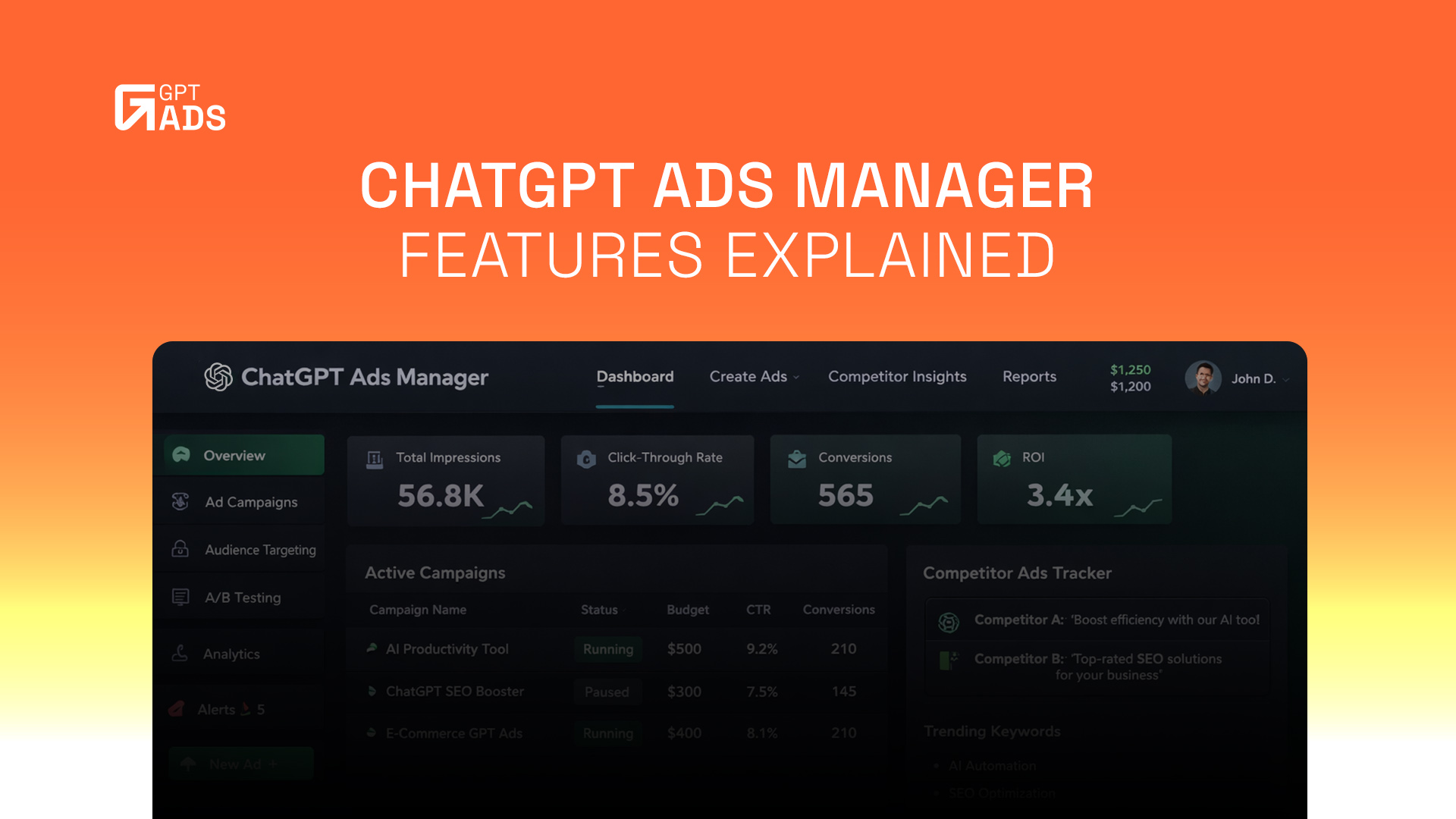
Once OpenAI opens the doors to this advertising platform, it will be time to create your first chatgpt ad. Early versions of the console will likely guide you through selecting a campaign objective, choosing intent‑based targeting, setting bids and budgets, and crafting your message. You might be able to start testing ads inside ChatGPT through a self‑service dashboard reminiscent of other ad managers. Remember that campaigns must align closely with user queries; ask yourself whether your message genuinely helps the user.
When you publish your first campaign, don’t expect instant scale. Start testing ads with small budgets and measure results. Use GPTAds to generate multiple ad variations and track click‑through rates, conversation engagement and conversion. After each iteration, refine your copy and target different intents. The ability to adjust creative quickly will help you find the sweet spot between useful information and promotion. If you’re unsure what resonates, you can spy on competitor campaigns using tools like GPTAds to gain inspiration and stay competitive.
Targeting and Bidding Options: What to Expect
Precise details about targeting and bidding have yet to be released, but we can infer how they might work. When you advertise on ChatGPT, you are addressing people who are actively seeking answers. This is a high‑intent audience of chatgpt users who trust the assistant for many important tasks. Because the bot has hundreds of millions of weekly active users, there will be room for niche and broad targeting alike. Expect to bid on conversation intents rather than keywords; the system may use underlying AI to match your product to queries. That means relevance and timing will outweigh brute force spending. This AI matching will likely leverage natural‑language understanding to connect your offering to the right question.
In an interview, analysts suggested that bidding might be similar to Google Ads and that advertising costs could start low but rise as competition increases. OpenAI says users will control personalization and can opt out, so advertisers will need to respect user preferences. For now, there is no way to see ads live because the feature hasn’t launched, but you can sketch out buyer personas and map them to conversation triggers. Budget for testing in 2026 but prepare for cost‑per‑clicks that reflect the premium of interacting with someone at the moment they’re about to make a purchase decision. When the feature launches, OpenAI is likely to release guidelines about targeting sensitive categories and how to handle chatgpt for help planning tasks like trips, purchases or learning.
Monitoring and Optimizing Ads on ChatGPT
After launch, successful advertisers will continuously monitor performance and optimize campaigns. Unlike search or social networks, time spent in ChatGPT is conversation‑driven, so measuring success requires new metrics. You’ll need to track not only clicks but also follow‑up questions, conversation length and ultimate conversions. One advantage of chat is that you can gauge whether a sponsored response truly helped the user. Use GPTAds’ AI‑powered analytics to see which ad variants drive engagement and where drop‑off occurs. If an ad invites a follow‑up question, you know it delivered value.
You should also watch how your campaigns affect brand perception. Because the environment is conversational, intrusive ads can be jarring. Ensure your chatgpt ad offers genuine help rather than a hard sell. Use competitor intelligence tools to observe how others position themselves. If you notice a competing paid ad performing well, analyze its messaging and adapt your own. Over time, you may decide to expand spending or pause campaigns depending on results. Remember that OpenAI pledges not to optimize for time spent, so success will be defined more by user satisfaction and conversions than by keeping people chatting.
Ethics, Privacy, and User Trust with ChatGPT Advertising
Ethical considerations are central to this rollout. Users trust ChatGPT for many important tasks, from research to life advice, so protecting that trust is paramount. OpenAI’s principles highlight mission alignment, answer independence, conversation privacy and user choice. That means conversations with ChatGPT private are off‑limits to marketers, and there are strict rules about the data used for ads. Ads will be separated from answers and clearly labeled, and you’ll know why a specific promotion appears.
Regulators and consumers will be watching how personalization is implemented. You can turn off personalization, dismiss ads and clear data at any point. This level of control may become a benchmark for other AI platforms. Transparency also matters: it must be clear that ads are ads, and OpenAI promises to keep user interactions private. For marketers, abiding by these rules is not optional. Violations could harm your brand and risk removal from the platform. The company has emphasized trust and user experience over revenue, so there is little tolerance for deceptive practices. With this in mind, plan campaigns that respect user autonomy and deliver value.
Regulators and consumers will be watching how personalization is implemented. You can turn off personalization, dismiss ads and clear data at any point. This level of control may become a benchmark for other AI platforms. Transparency also matters: it must be clear that ads are ads, and OpenAI promises to keep user interactions private. For marketers, abiding by these rules is not optional. Violations could harm your brand and risk removal from the platform. The company has emphasized trust and user experience over revenue, so there is little tolerance for deceptive practices. With this in mind, plan campaigns that respect user autonomy and deliver value. These ethical considerations are part of the broader AI safety discourse.
What Does the Future Hold for ChatGPT Advertising?
Looking ahead to 2026, this initiative could reshape conversational commerce. In early tests, OpenAI said it will keep ads limited to the U.S., but it’s reasonable to expect geographic expansion if the model proves successful. Analysts predict that chatgpt advertising will likely evolve into richer experiences, perhaps even allowing people to book hotels or order products directly within the chat. As the AI ecosystem matures, expect features like voice interactions and multimodal ad formats. Because so many weekly active users interact with the assistant, there will be ample room for innovation. Competitors, from Anthropic to Google, will watch closely; the success of ChatGPT ads could pressure them to launch similar programs.
For marketers, this is both exciting and challenging. ChatGPT ads will likely require a deeper understanding of user intent than other channels. The environment isn’t about shouting your message but about showing up when someone genuinely needs help. With careful preparation and tools like GPTAds, you can join the beta and adapt quickly. The key is to deliver truly useful information within the chat and respect user preferences. It will also be important to monitor openai ceo announcements and developer blogs so you can adjust strategy as the platform evolves. Although the system is not yet live, ads are coming, and being ready may give you a head start.
Step‑By‑Step Preparation and Launch Process
| Step | Before the launch | After the launch |
|---|---|---|
| 1 | Map product offerings to conversation intents and plan how to advertise on ChatGPT | Use OpenAI’s console to create your first chatgpt ad and set budgets |
| 2 | Audit and improve landing pages to match conversational journeys | Adjust bids and targeting as you start testing ads and collect data |
| 3 | Allocate budgets and estimate advertising costs for different scenarios | Analyze performance in GPTAds, refine creative and increase spend |
| 4 | Generate creative assets (copy, images) using GPTAds and plan multiple variations | Spy on competitor campaigns and iterate to improve results |
| 5 | Monitor OpenAI announcements so you can move quickly when testing ads begins | Expand campaigns, explore new ad formats and scale successful ads |
Create, Optimize, and Track ChatGPT Ads With GPTAds
GPTAds is built specifically for the new era of chatgpt advertising, where ads appear inside conversations and compete on relevance, timing, and usefulness rather than sheer budget. Instead of forcing traditional ad workflows into a conversational environment, GPTAds is designed around how ChatGPT actually works.
Create ChatGPT Ads the Right Way
Creating a chatgpt ad is fundamentally different from writing search or social copy. Users are mid-conversation, often trying to solve a problem or make a decision. GPTAds helps you create ads that feel native to that moment.
With GPTAds, you can:
- Generate ad copy aligned to real conversation intents users ask in ChatGPT.
- Create multiple ad variations optimized for different stages of the user journey.
- Generate images and short text formats suitable for conversational placements.
- Prepare creatives before OpenAI officially allows advertisers to advertise on ChatGPT.
This lets you enter the platform ready, instead of scrambling after ads go live.
Optimize for Intent, Not Keywords
Unlike google ads, ChatGPT ads are not driven by classic keyword matching. They are driven by intent, context, and timing inside conversations with ChatGPT. GPTAds helps you optimize for that shift.
You can:
- Identify high-intent conversation themes worth targeting.
- Rewrite ads to match how users phrase questions naturally.
- Optimize messaging based on follow-up questions and engagement signals.
- Test multiple versions before and after OpenAI start testing ads inside ChatGPT.
This optimization approach aligns with how AI interprets meaning, not just search terms.
Track Performance and Learn Faster
Tracking ads in chat environments requires new thinking. GPTAds gives you visibility into what matters for ChatGPT ads.
With GPTAds, you can:
- Track which conversation intents trigger your ads most often.
- Monitor clicks, engagement, and downstream actions.
- Compare your ads against competitors that appear in ChatGPT.
- Spy on competitor ChatGPT ads to get ideas and improve performance.
This is especially valuable as OpenAI rolls out its advertising platform and reporting matures over time.
Built for the ChatGPT Ads Era
GPTAds is not a generic ad tool. It is first of a kind tool built for chatgpt advertising, and for marketers who want to move early. Whether you are a startup, SaaS company, or digital marketing agency, GPTAds helps you prepare, launch, and scale as ChatGPT ads evolve through 2026 and beyond.
Instead of guessing how ads will perform inside ChatGPT, GPTAds lets you build, test, and iterate with confidence from day one.
Frequently Asked Questions
1. When will ChatGPT ads roll out?
OpenAI intends to start testing ads for logged‑in U.S. adults on the free and Go tiers in the coming weeks. The exact launch date hasn’t been confirmed.
2. Who will see ads and who won’t?
Adults on the free tier and Go plan may see promotions, while Plus, Pro, Business and Enterprise subscribers will remain ad‑free. Under‑18 users and chats on sensitive topics won’t see ads.
3. Will ads influence ChatGPT’s responses?
No. ChatGPT’s responses are generated independently and are never by advertising. Sponsored messages appear below the answer.
4. How will my data be used for ads?
OpenAI says your conversations remain private, and your data isn’t sold. You can clear data used for ads and turn off personalization at any time.
5. Can I opt out of personalized ads?
Yes. You can disable personalization, dismiss specific ads and clear ad‑related data. There will also be a paid tier that remains ad‑free.
6. How much will it cost to run ads?
Pricing hasn’t been announced. Analysts expect bidding to be similar to Google Ads, but openai said details will come later. Plan for flexible budgets and monitor advertising costs during testing.
7. How do I create a campaign?
After the launch, you’ll use a self‑service dashboard to create a chatgpt ad, choose intents to target and set bids. Tools like GPTAds can help generate creative and track results.
8. How is this different from other ad platforms?
Unlike search or social networks, ChatGPT placements occur within a conversation. Users trust ChatGPT for many important tasks, so your ads must feel helpful. This makes it a unique advertising platform for high‑intent moments.
9. Is conversation privacy maintained?
Yes. OpenAI ceo Sam Altman has said that conversations with ChatGPT private will stay private and that the company will not share user data with marketers. Ads are separate from answers and are always clearly labeled.