Large language models are quickly becoming a new gateway to discovery. When people ask ChatGPT for help choosing products or services, they are usually further down the decision‑making funnel than someone entering a generic search. OpenAI announced in January 2026 that it will begin testing ads on ChatGPT. The ads will be shown only to free and Go tier users in the United States, appear at the bottom of answers and be clearly labeled. Ads will not be shown to under‑18 users or near sensitive topics like health, mental health or politics. For now there is no public ChatGPT Ads Manager, no pricing information and no details on targeting or campaign structure. Yet this high‑intent ad placement could change marketing as we know it.
This post explores what we know today and what advertisers can expect from a future ChatGPT Ads Manager. We’ll compare potential features with those of established platforms like Google Ads, Meta Ads, LinkedIn Ads, X and TikTok, draw out the implications for marketers and outline how GPTAds (our tool for ad creation, optimization and competitive intelligence) can help you prepare.
TLDR
- ChatGPT ads aren’t live yet. Early tests will show ads to free and Go users in the U.S., at the bottom of answers and clearly separated from the AI’s response. Plus, Pro, Business, Enterprise and Education tiers remain ad‑free.
- Ads respect user trust. OpenAI promises that ads won’t influence ChatGPT’s answers, that conversations aren’t shared with advertisers and that users can turn off personalization. Ads will not appear near sensitive topics.
- No Ads Manager yet. OpenAI hasn’t announced a self‑serve interface or details on bidding, targeting or analytics.
- High‑intent opportunity. When a user asks ChatGPT for recommendations, they signal specific intent. Brands that get visibility at this moment could see higher conversion rates than through traditional keyword‑based search ads.
- Prepare now. Use tools like GPTAds to research prompts, monitor competitor visibility and craft conversation‑native ad copy. When the Ads Manager launches, early movers will be ready to dominate the AI discovery layer.
What We Know About ChatGPT Ads
OpenAI’s January 2026 announcement set expectations for the first experiment with ads. Here are the confirmed facts:
- Placement and format. Ads will appear below ChatGPT’s response in a separate module. They are triggered based on the conversation’s context, not on simple keyword matches. Users can learn why they are seeing a particular ad and dismiss it.
- Eligibility. Only free and Go tier users in the U.S. who are adults will see ads. Paid plans (Plus, Pro, Business, Enterprise and Edu) remain ad‑free. Under‑18 accounts and chats around sensitive topics like health, mental health and politics are excluded.
- Answer independence and privacy. OpenAI asserts that ads will not influence the content of answers. Conversations will not be shared with advertisers, and users can control personalization and clear ad data at any time.
- Unknown details. OpenAI has not yet shared details on ad formats beyond simple sponsored modules, pricing or bidding models, targeting options, reporting dashboards or a self‑serve Ads Manager. Internal documents indicate that an advertising infrastructure is being built with campaign management tools and real‑time attribution pipelines, and the company plans to monetize free users. But specifics remain under wraps.
These guardrails are designed to preserve user trust while monetizing a free product. They also suggest that the first iteration of ChatGPT ads will be relatively conservative, a single, clearly marked unit for high‑intent queries.
Features of ChatGPT Ads Manager
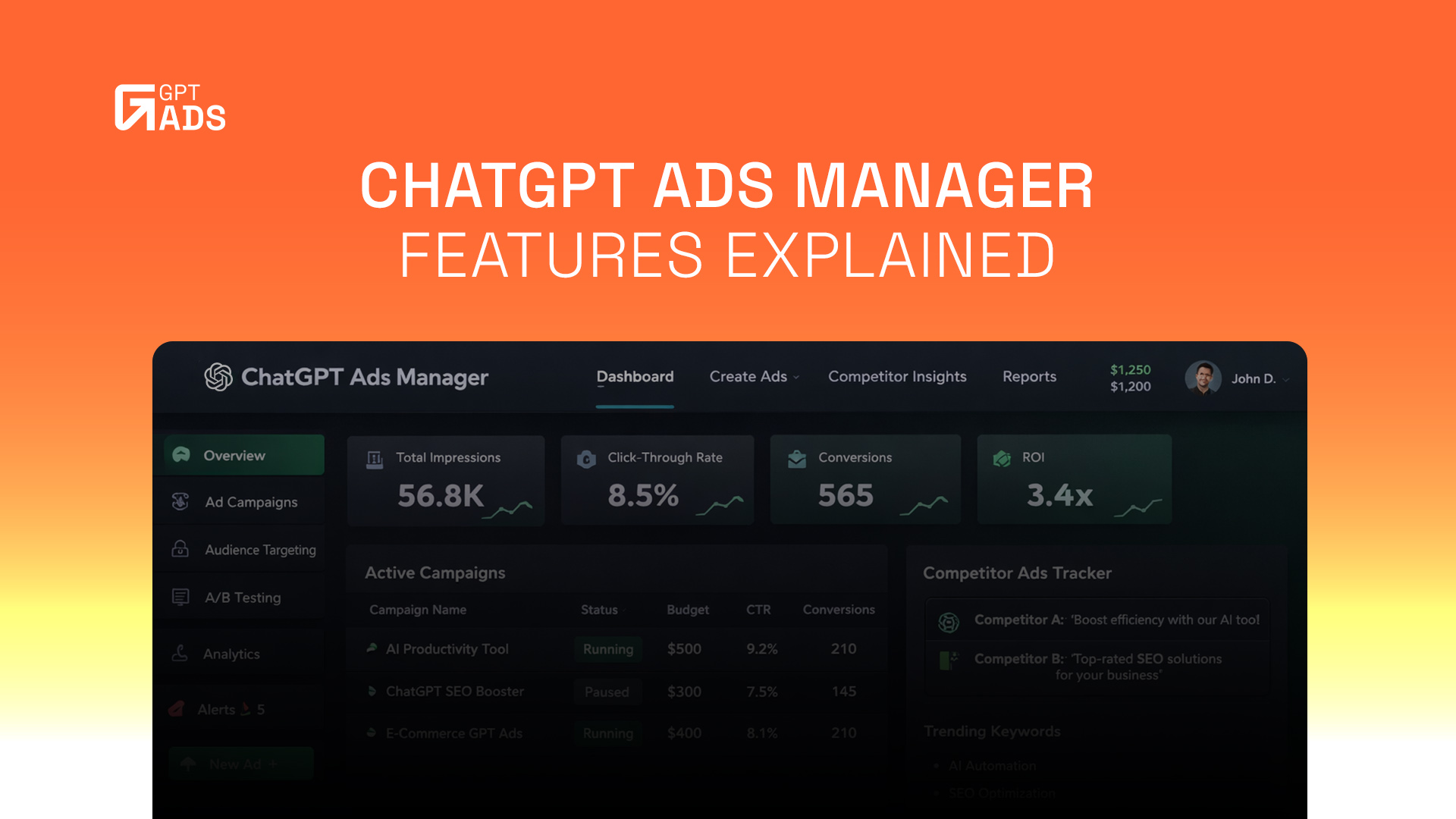
Because there is no official Ads Manager yet, we can only infer potential features by looking at OpenAI’s principles and by comparing them to existing ad platforms. Below is a table summarizing features an advertiser might expect when ChatGPT ads become self‑serve, along with why each feature matters and how comparable platforms handle it.
| Feature | Why it matters | Comparable platform examples |
|---|---|---|
| Conversation‑intent targeting | Ads would be matched to the meaning and intent of user prompts rather than keywords. This requires natural language understanding and could deliver highly relevant ads without needing cookie‑based profiles. | Google Ads allows advertisers to target keywords and audiences by demographic and location, but ChatGPT could go deeper by using full conversation context. |
| Prompt clusters and funnel mapping | Advertisers could group prompts into stages (discovery, consideration, decision) and align ad copy accordingly. This concept mirrors prompt research suggested by GenRank. | Meta Ads campaigns are built with objectives like awareness, traffic and conversions, each with distinct creative and bidding strategies. |
| Interactive ad formats | Ads might let users engage with the sponsor, ask follow‑up questions, schedule demos or purchase directly from within ChatGPT, as hinted by early mockups. | X offers vertical video ads with a call‑to‑action button after one second. TikTok’s TopView and in‑feed ads include interactive CTAs. |
| Cost‑per‑conversation bidding | Instead of paying per click, advertisers might pay when a user engages with the ad or begins a conversation with the brand. This would reflect the conversational nature of the medium. | Google Ads typically charges per click or per impression. CPA bidding exists on several platforms but not tied to conversations. |
| Real‑time conversation analytics | Advertisers need metrics such as ad impressions, engagement rate, dismissal rate, follow‑up questions and downstream conversions. Metrics may include conversation sentiment and satisfaction. | Google Ads provides click and conversion data; Meta Ads offers detailed breakdowns at the campaign, ad set and ad level. |
| A/B testing and creative optimization | The ability to run multiple ad prompts and measure which phrasing leads to more engagement. A/B testing is central to GPTAds’ offering. | Google Ads and Meta Ads both support A/B testing of creatives; GPTAds already allows marketers to generate high‑converting ChatGPT ads from structured prompts. |
| Competitor ads intelligence | Marketers will want to monitor which brands are appearing in conversations and how often, similar to GPTAds’ competitor tracker. | Tools like SEMrush monitor competitor keywords for search ads, and GPTAds already tracks competitor ChatGPT ads. |
| Integration with CRM and analytics platforms | To attribute conversions from ChatGPT to sales or leads, the Ads Manager would need hooks into platforms like HubSpot and Slack. | Most modern ad platforms integrate with CRMs (e.g., HubSpot and Salesforce) and analytics suites. |
| Safety and compliance filters | Advertisers will need to know which topics are off‑limits and ensure that copy meets regulations. OpenAI has said ads won’t appear near sensitive topics. | Meta, Google and TikTok all enforce ad policies around prohibited content, and LinkedIn offers professional audience targeting with compliance considerations. |
These features align with OpenAI’s mission of answer independence, conversation privacy and user control. They also reflect lessons from existing ad managers: transparency, granular targeting, flexible bidding and robust analytics.
Comparing ChatGPT Ads with Existing Platforms
To understand what ChatGPT Ads Manager might offer, it helps to contrast it with today’s leading ad platforms:
Google Ads
Google Ads dominates search advertising by matching user queries to keywords and displaying ads above or below organic results. Advertisers can target users based on keywords, geographic location, age, language, schedule and device. Cost control is flexible, advertisers set budgets per month, day or campaign and pay only when someone clicks. Detailed analytics measure clicks and conversions. In contrast, ChatGPT ads will not rely on keyword triggers alone; instead they will analyze full conversational context and likely charge per engagement rather than per click.
Meta Ads (Facebook/Instagram)
Meta Ads manage campaigns via a three‑level hierarchy: campaigns (objectives), ad sets (targeting, placement and budget) and ads (creative formats). Objectives include brand awareness, traffic, lead generation and conversions. Targeting options extend from core demographics to custom and lookalike audiences. Ad formats range from single image/video to carousel, collection, stories and reels. ChatGPT ads will likely adopt a simpler structure at first, focusing on a single placement below the answer. However, a future Ads Manager may allow segmentation by prompt intent, similar to Meta’s objectives.
LinkedIn Ads
LinkedIn Ads target professionals using attributes such as company, job experience, education, demographics and interests. LinkedIn’s Campaign Manager offers Classic ad sets (manual audience building) and Accelerate ad sets, which use AI to automatically create audience segments. ChatGPT ads will not rely on user profile data; instead they will rely on conversation meaning. If OpenAI introduces an “accelerate” mode, it could use AI to suggest prompt clusters and recommended creative.
X (formerly Twitter) Ads
X offers several ad formats designed to be integrated into the timeline. Promoted Ads look like regular posts and can include text, images or videos; they are labeled “Promoted”. Vertical Video Ads are full‑screen, sound‑on videos within the vertical video feed and display a call‑to‑action after one second. Collection Ads feature a hero image with thumbnail products, allowing users to browse and click individual products. These formats emphasize engaging visuals; ChatGPT’s initial ads will be more textual and recommendation‑oriented, but interactive modules could emulate X’s focus on engaging formats.
TikTok Ads
TikTok’s ad ecosystem encourages participation. In‑feed ads appear within the user’s scrolling feed with a call‑to‑action button. TopView ads are premium full‑screen placements that show as the first video when the app opens. Branded hashtag challenges invite users to create content around a theme, driving viral UGC. Branded effects let advertisers create lenses or stickers. Spark ads amplify existing organic videos, and E‑commerce ads integrate shopping features. While ChatGPT will not replicate these immersive video formats, its ads could borrow the idea of user participation. Imagine letting users ask follow‑up questions or see product demos directly within the chat.
How GPTAds Helps You Prepare for ChatGPT Ads
At GPTAds, we anticipate the future of conversational advertising and provide tools to help brands win the AI discovery era. Our platform goes beyond simple copy generation. Here’s how GPTAds can prepare you for ChatGPT Ads Manager:
- High‑converting ad creation. GPTAds lets you generate conversation‑native ad copy from one prompt and A/B test multiple variations. Structured prompts are tuned for ChatGPT’s conversational style, ensuring your ads read like helpful recommendations rather than intrusive banners.
- Competitor ad tracker. Our competitor tracker monitors which brands appear inside ChatGPT responses, how often they surface and what messaging they use. This insight helps you identify market gaps and craft differentiating angles.
- Ad angle and intent mapping. GPTAds analyzes prompts to discover which user questions trigger commercial responses. You can map prompts to different stages of the funnel (discovery, consideration, decision) and plan your creative accordingly.
- Analytics and dashboards. Real‑time tracking reports show where your ads are appearing, how they perform and how users engage. Integrations with Slack, HubSpot and Zendesk let your team receive alerts and collaborate seamlessly.
- Designed for early advertisers. As ChatGPT ads roll out, first movers will have an advantage. GPTAds is built for founders, marketers and growth teams who want to move early and dominate the AI attention layer. Our platform helps you capture first‑mover advantage, build conversation‑native ads and understand AI‑driven discovery before the masses arrive.
Advertisers who act early will gain a competitive edge. GPTAds is built to help you create high‑converting conversation‑native ads, understand prompt‑level opportunities and track competitor activities. When ChatGPT Ads Manager launches, you’ll be ready to capture high‑intent traffic, optimize your campaigns and stay ahead of the competition.
Frequently Asked Questions (FAQ): ChatGPT Ads Manager Features
1. What are ChatGPT ads?
ChatGPT ads are native advertising modules that will appear at the bottom of ChatGPT answers. They are context‑aware recommendations tied to the user’s current conversation.
2. When will ChatGPT Ads Manager be available?
OpenAI has not yet announced a public Ads Manager. The company is currently testing ads internally with free and Go users in the U.S.. Details on a self‑serve interface are unknown.
3. What targeting options will ChatGPT ads offer?
OpenAI has not disclosed targeting controls. Based on the nature of LLMs, targeting will likely focus on conversational intent rather than demographics. For example, prompts like “best CRM for startups” could trigger ads for SaaS CRMs. A future Ads Manager may allow prompt clusters and funnel mapping.
4. How will bidding work?
Pricing models haven’t been revealed. Traditional platforms use cost‑per‑click or cost‑per‑impression models. A ChatGPT Ads Manager might introduce cost‑per‑conversation or cost‑per‑engagement, charging only when a user interacts with the ad.
5. Will ads influence ChatGPT’s answers?
OpenAI says no. Ads are separate, clearly labeled modules that do not influence the AI’s answer. The system aims to maintain answer independence and user trust.
6. Are there restrictions on which topics can have ads?
Yes. Ads will not appear near sensitive or regulated topics such as health, mental health or politics. Users under 18 will also not see ads.
7. What creative formats will be allowed?
The initial test uses a simple sponsored module. However, OpenAI’s mockups hint at interactive features where users can ask questions directly about the ad. Over time, we may see conversational prompts, lead forms or even product demos embedded in the chat.
8. How will privacy be protected?
OpenAI promises that it will not share conversation data with advertisers and that users can control personalization. Aggregated performance metrics may be shared with advertisers, similar to how other platforms provide reporting while protecting user identities.
9. How can I prepare my business for ChatGPT ads?
Start by understanding the prompts your customers use when researching your product. Build landing pages and proof points that align with those prompts. Use GPTAds to map prompts to intent stages, test conversation‑native copy and monitor competitor visibility. When the Ads Manager launches, you’ll already have the creative, insights and infrastructure needed to succeed.